


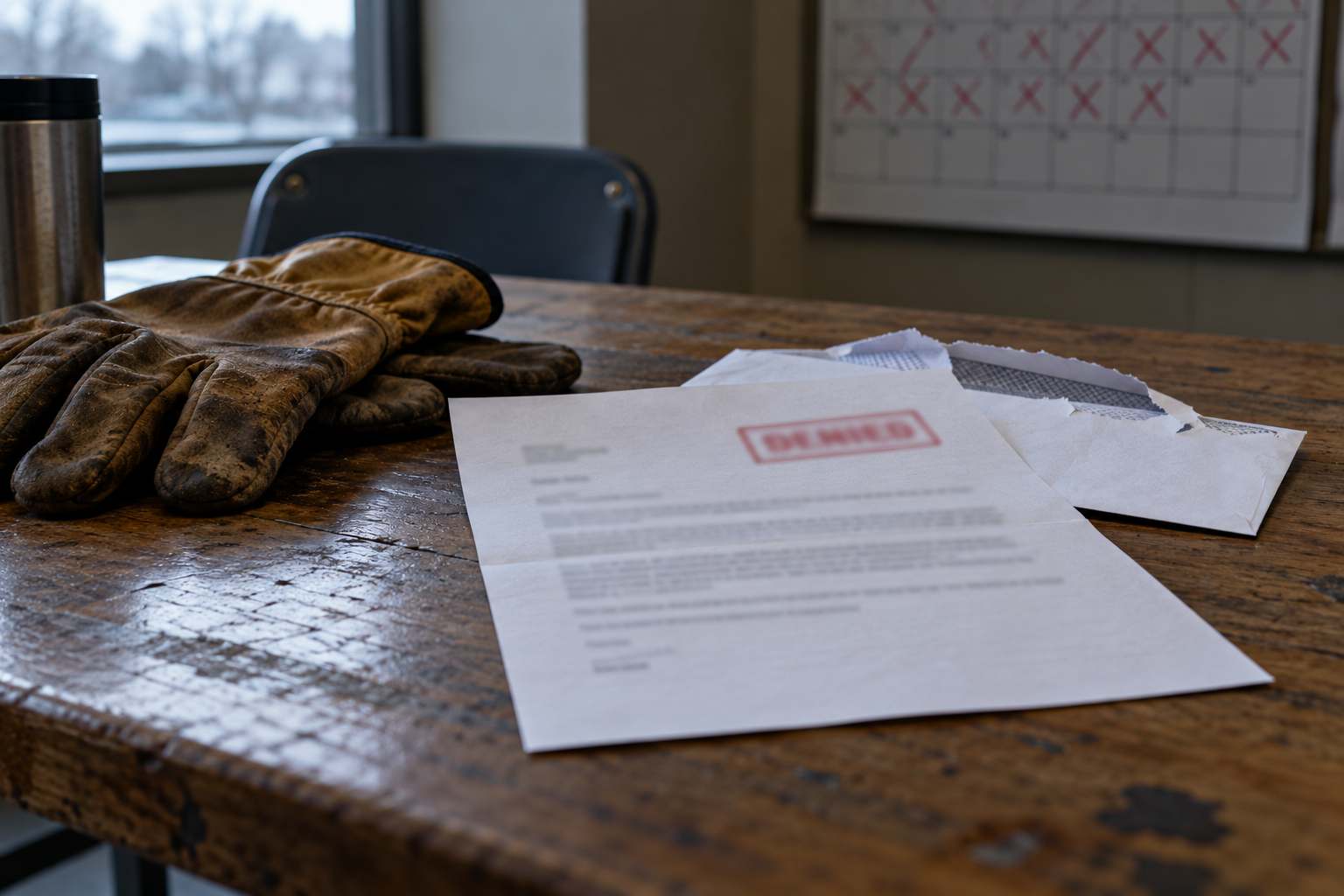
You didn’t think much of the ache in your shoulder the day it started, so you kept working through the week the way you always have. By the time you finally said something to your supervisor, weeks had passed. Now the denial letter says you reported too late, as if the timing matters more than the injury itself. You’re trying to remember exactly when it started hurting enough to call it an injury, and whether that moment is the one that just cost you your claim.
The Law Offices of Arechigo & Stokka understands how easy it is to underestimate an injury until it’s too late to report it as required by the rules. We step in to help you find out if a late-notice denial is really the end of your claim.
Workers’ Comp Claim Denied for Late Notice? Four Facts That Matter
If your workers’ comp claim was denied because the insurer says you reported the injury too late, the deadline is less absolute than the letter makes it sound. Minnesota treats late notice as a sliding scale, and where you fall on it changes everything.
- The first deadline is 14 days, and missing it is not fatal. The statute calls for written notice within 14 days unless your employer already knew about the injury. Miss it and compensation is not due until notice is given or knowledge is obtained, which delays benefits rather than ending them (Minn. Stat. § 176.141).
- Up to 30 days, the burden is on your employer. Within that window, a late or flawed notice cannot bar your claim unless the employer proves it was actually harmed by the delay, and then only to the extent of that harm.
- From day 31 through day 180, you need a good reason. Compensation can still be allowed if you show the delay was excusable, such as honest mistake, ignorance of the facts or the law, inability to report, or employer misrepresentation. The employer can still reduce your benefits by whatever prejudice it proves.
- Day 180 is the hard wall, with limited exceptions. If your employer never learned of the injury and never received written notice within 180 days, compensation is generally barred. The exception is an employee too physically or mentally incapacitated to give notice, whose 180 days run from when the incapacity ends.
A Denial Letter Is Not a Ruling
An Insurer Saying No Does Not Make It the Final Answer
Getting that letter while you are hurt, behind on bills, and unable to work is a hard day. But a denial is only the insurer’s position, and the law gives injured workers more room than the letter suggests. Let us look at your dates and tell you honestly where your claim stands.
Schedule A Free ConsultationIs a Late-Notice Denial the End of Your Claim?
No, not necessarily. A workers’ comp claim denied for late notice may still move forward if the insurer used the wrong starting date, the employer already had actual knowledge, or a statutory exception applies.
A denial letter states the insurer’s position, not a compensation judge’s ruling. Minnesota rules require a specific, understandable reason and supporting facts. The stated injury date, reporting date, and person who received notice may help identify where the dispute lies.
How Long Do You Have to Report a Work Injury?
The safest answer to the question of how long to report a work injury is immediately. Minnesota law, however, does not treat every report after 14 days as an automatic loss.
Minnesota law creates four important periods, including:
- Within 14 days. Give written notice unless the employer already knows about the injury.
- Within 30 days. A defect or delay generally cannot bar compensation unless the employer proves prejudice.
- From day 31 through day 180. The worker usually must show mistake, inadvertence, ignorance of fact or law, inability, or fraud, misrepresentation, or deceit by the employer or its agent.
- After 180 days, compensation is generally barred unless mental or physical incapacity prevented notice.
Prejudice does not mean personal bias. It means the delay actually placed the employer at a disadvantage, such as losing an opportunity to investigate the scene, speak with witnesses, or respond to the injury. The employer must prove that the disadvantage. The law limits the consequences to the proven harm.
Occupational-disease claims follow a different statutory rule, so these time periods should not be applied to every disease caused by workplace exposure.
What Can Count as Notice to the Employer?
Notice to your employer can take many forms.
Formal Written Notice
Minnesota recognizes written notice and the employer’s actual knowledge. Formal notice should identify the worker, injury, work connection, approximate date, and location. State law lists personal delivery and certified mail as service methods.
Email or Text
An email or text to a supervisor or human-resources representative may be important evidence of what the employer learned and when. But the formal-notice statute does not expressly list ordinary email or text messaging. Do not assume that any electronic message settles the issue. Save the exchange for your records, follow the employer’s reporting process, and provide a written report with proof of delivery.
Oral Notice and Actual Knowledge
Conversations matter too. A supervisor’s knowledge may be attributable to the employer in certain circumstances. The conversation must convey more than the fact that the worker feels pain. The employer needs information connecting the condition or accident to work. Telling a manager that your back hurts is different from explaining that it began while lifting inventory during your shift.
When Can a Denied Workers’ Comp Claim Still Move Forward?
First, the notice clock may have started later than the insurer claims. With a sudden accident, the date is often apparent. With repetitive trauma, symptoms may develop slowly. Minnesota courts ask when it became reasonably apparent to the worker that the injury had caused, or was likely to cause, a compensable disability. That is a factual question. A formal medical opinion is not always required, but early aches do not automatically start the clock either.
Second, a report made within 180 days may qualify under one of the statute’s listed explanations. A worker might reasonably believe an injury was minor and would resolve, misunderstand that repetitive duties could produce a work injury, or learn later that an accident worsened an existing condition. These facts do not guarantee benefits. They create issues that must be supported with testimony, records, and a credible timeline.
What Evidence Can Challenge the Insurer’s Timeline?
Start with records created near the injury, including:
- The denial letter and injury reports;
- Emails, texts, and work schedules;
- Medical notes and work restrictions; and
- Photographs and witness names.
A supervisor’s message acknowledging the accident may support actual knowledge. A medical record documenting when the work connection became apparent may affect the start of the notice period.
Preserve original messages rather than relying on memory or summaries. Be sure to note who participated in each conversation and what was said. Consistency among workplace records, medical histories, and testimony can become critical when dates are disputed.
Free, Confidential, No Pressure
Waiting Quietly Is the One Move That Hurts Your Case
The rules on notice are built around dates, and the insurer is already assembling its own timeline. Bring us what you remember about when you were hurt and who you told, and we will help you build the record before the other side finishes theirs.
Schedule A Free ConsultationWhat Happens After a Late-Notice Denial?
Possible next steps include:
- Ask the adjuster to reconsider the decision and provide the missing records;
- Seek dispute-resolution assistance or mediation from Minnesota’s Department of Labor and Industry; and
- If primary liability remains denied, request a hearing by filing an Employee’s Claim Petition.
The petition must address the employer’s notice or knowledge and include supporting medical and factual information.
Separate deadlines govern the filing of a workers’ comp denied proceeding. Waiting after a denial can create another dispute, so a worker should promptly review the letter and any available evidence.
Build the Record with Arechigo & Stokka On Your Side
When an insurance company denies a workers’ compensation claim over a notice deadline, someone needs to fight that denial line by line. Arechigo & Stokka has created its workers’ compensation practice around exactly that kind of accountability since John and Josh founded the firm in St. Paul in 2007. They are determined to assign clients the same lawyer from the first call to the final resolution. That client-first history has earned Arechigo & Stokka a 4.9 out of 5 rating across 184 third-party reviews, and its two attorneys still handle the courtroom work themselves.
You Kept Up Your End. Make Sure They Keep Up Theirs
A late-notice denial deserves a fact-specific review. Contact Arechigo & Stokka to discuss what your employer knew, when the notice period began, and what options may remain for pursuing benefits.
Legal References Used to Inform This Page:
To ensure the accuracy and clarity of this page, we referenced official legal and other resources during the content development process:
- Notice of Injury, Minn. Stat. § 176.141.
- Denials of Liability, Minn. R. 5220.2570.
- Ruter v. Hennepin Paper Co., Minnesota Workers’ Compensation Court of Appeals.
- Time Limitations, Minn. Stat. § 176.151.
- Service of Notice, Form, Minn. Stat. § 176.145.
- Soule v. Forest Lake Clinic, Minnesota Workers’ Compensation Court of Appeals.
- Anderson v. Frontier Communications, Minnesota Supreme Court.
- Schmidt v. Wal-Mart Stores, Inc., Minnesota Supreme Court.
- Minnesota Department of Labor and Industry, Claim Process FAQs.
- Disputes, Petitions, and Procedure, Minn. Stat. § 176.291.