


You’re sitting in the courtroom hallway with your public defender, and they’re walking you through the plea deal like it’s the end of the conversation. It sounds manageable, a fine, some classes, nothing that sounds like it should follow you home. Nobody in that hallway has asked what you do for a living, and you’re starting to wonder if that matters more than anyone’s told you. You have a license, a certification, a status that took years to get, and no one has explained what happens to any of it once you sign. The Law Offices of Arechigo & Stokka understands that a plea deal can carry consequences far outside the courtroom, and we step in to help you understand what’s actually at stake before you agree to anything.
Collateral Consequences of a Criminal Charge: What Follows You Out of Court
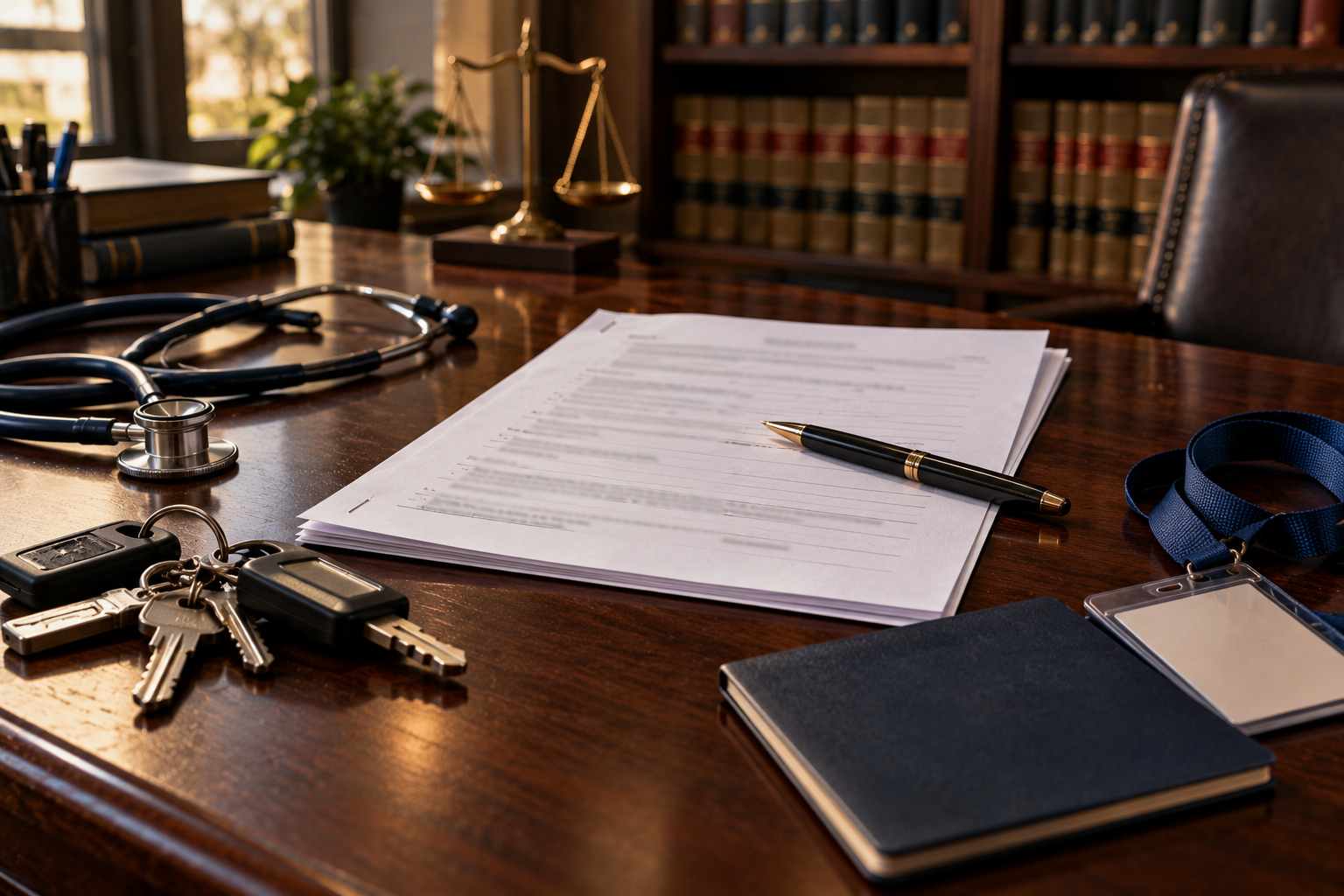
The collateral consequences of a criminal charge often land harder than the sentence itself, and they come from people who are not in the courtroom. Here is how that plays out for four groups who are regularly caught off guard.
- Damage can start before any verdict, and a good result in court does not undo it. A school can keep a teacher out of a classroom assignment while certain serious charges are pending, and licensing boards, the DPS, and immigration officials each decide for themselves, so an acquittal does not automatically bind them.
- A misdemeanor is not automatically safe for a licensed professional. The Board of Nursing’s conviction-based discipline reaches felonies and gross misdemeanors reasonably related to nursing (Minn. Stat. § 148.261), but the Board can still look into the conduct behind a charge for issues like unsafe practice or false statements.
- Commercial drivers face fixed penalties. A first conviction for impaired driving or refusing an alcohol test brings a one-year CDL disqualification, and two serious traffic violations within three years bring a 60-day disqualification (49 C.F.R. § 383.51).
- A plea that looks like a win can still count as a conviction for immigration purposes. Under federal law, a withheld adjudication counts when you plead or admit enough facts and the court orders some punishment or restraint (8 U.S.C. § 1101(a)(48)(A)), which is why the wording of a plea matters before you sign.
More Than the Case Is at Stake
Your Job, Your License, and Your Status Belong in the Conversation
The fine and the sentence are rarely what keep people awake at night. It is the paycheck, the career, the right to stay in the country. Those worries are fair, and a good defense accounts for them from the very first meeting. Tell us what you stand to lose, and we will build around it.
Schedule A Free ConsultationWhat Can a Criminal Charge Put at Risk Beyond the Courtroom?
The collateral consequences of a criminal charge can affect:
- A professional license,
- Commercial driving privileges,
- A teaching position, and
- Immigration status.
Each system follows its own rules and may define a conviction differently.
Why Does the Next Decision-Maker Matter?
The warning many criminal-case guides skip involves timing. A resolution may look favorable under Minnesota criminal law, but a licensing board, the Department of Public Safety, a school district, or immigration officials may apply a different rule.
A stay of adjudication illustrates the problem. A Minnesota court may accept a guilty plea, withhold the conviction, impose conditions, and dismiss the case upon successful completion of those conditions. However, another licensing agency may still examine the plea, the court’s findings, the conditions, and the conduct underlying the case and use that information to remove your privileges as a license holder.
Can You Lose Your Nursing License for a Misdemeanor?
An ordinary misdemeanor conviction does not appear in the nursing law’s conviction-based ground for discipline. That provision covers a felony or gross misdemeanor reasonably related to nursing. The Minnesota Board of Nursing may still investigate the underlying conduct for possible violations involving:
- Fraud or unethical conduct,
- Unsafe practice,
- Controlled-substance violations, and
- False statements to the Board.
The criminal court does not take the nursing license, but the Board may exercise its control over a separate proceeding either by agreement with the nurse or following a formal hearing. The Board can deny, suspend, limit, condition, or revoke a license when the evidence establishes a statutory ground. A nurse, therefore, needs to evaluate both the criminal defense and the Board’s possible response.
Which CDL Disqualifying Offenses Can Stop You from Driving?
Minnesota applies federal commercial driver disqualification rules, so the result depends on the offense, vehicle, and the driver’s history.
Major Offenses
Major offenses include:
- Impaired driving,
- Refusing a required alcohol test,
- Leaving an accident scene, and
- Using a vehicle to commit certain felonies.
A first major offense commonly results in a one-year commercial-driving disqualification. Some later offenses can result in a lifetime disqualification.
Serious Traffic Violations
Federal rules define serious traffic violations narrowly, including:
- Driving at least 15 mph over the limit;
- Reckless driving or improper lane changes;
- Following too closely; and
- Certain fatal-crash, commercial-license, or distracted-driving violations.
Two qualifying convictions from separate incidents within three years trigger a 60-day disqualification; three convictions trigger a 120-day disqualification. For a violation involving a personal vehicle, the rule applies only when the conviction also results in a suspension, revocation, or cancellation of ordinary driving privileges.
Diversion and Deferred Judgment
The CDL disqualifying offenses rules also limit certain traffic case resolutions. Minnesota courts cannot use deferred judgment or diversion to keep a covered traffic conviction from appearing on a CDL holder’s driving record, even when the person drove a personal vehicle. This restriction does not prohibit every diversion program for every criminal charge, but it can remove an option that another driver might receive.
How Can a Charge Affect a Minnesota Teacher Before Trial?
The License and the Job Are Separate
Minnesota separates teaching-license actions from school-employment actions. When prosecutors file certain serious charges, including offenses that may require predatory-offender registration, a school may choose not to assign the teacher to a teaching position while the charges remain pending. The licensing board controls the license, while the school district controls the teacher’s job under a separate employment process.
When an Unpaid Suspension Is Possible
A felony charge does not automatically create an unpaid suspension for every teacher. In school districts governed by the continuing-contract statute, the school board may suspend a teacher without pay only when prosecutors file a felony charge, and the alleged conduct would independently support proposed immediate discharge. The district must provide written grounds and an opportunity for a hearing.
If the final employment decision imposes no penalty, suspension, termination, or discharge, the district must repay the withheld compensation. A criminal acquittal does not automatically resolve the employment case, as the board or arbitrator evaluates conduct only under employment standards.
What Misdemeanor Immigration Consequences Can Follow a Plea?
Federal immigration law does not rely only on Minnesota’s felony or misdemeanor label. It examines the offense, statutory elements, sentence, a person’s status, and criminal record. Potential grounds include crimes involving:
- Moral turpitude or controlled substances;
- Domestic violence, stalking, or child abuse;
- Firearms; and
- Protection-order violations.
These offenses can create inadmissibility or deportability issues.
The definition of conviction creates another risk. Federal law recognizes one path when a court formally enters judgment. It recognizes a separate path when the court withholds adjudication. Still, the person pleads guilty or no contest, admits sufficient facts, or receives a finding of guilt, and the judge imposes a punishment, penalty, or restraint. These misdemeanor immigration consequences make the exact plea and court order more important than the state label alone.
Before You Say Yes to Any Offer
The Fine Print of a Plea Can Outweigh the Sentence
An offer that sounds fair in the courthouse hallway can carry consequences no one mentions until it is too late to change your answer. Call us first. We will read the deal against your career, your license, and your future, and tell you plainly what it would really cost.
Schedule A Free ConsultationHow Can We Help Address the Collateral Consequences of a Criminal Charge?
The Law Offices of Arechigo & Stokka opened its doors in 2007, when John and Josh, friends for years before they were law partners, set out to build the kind of defense practice they felt Minnesota needed: one where a client’s lawyer never changes or disappears behind a receptionist. That promise matters most if you are facing charges and cannot afford a defense team that treats your license or your status as an afterthought. Based in St. Paul, the two-attorney firm has carried that approach through hundreds of cases. It holds a 4.9 out of 5 rating across 184 third-party reviews, a track record built by clients who needed someone who understood exactly what a conviction could cost them beyond the courtroom.
Get a Real Answer, Not a Runaround
The wording of a plea, the level of the offense, and the court’s final order can affect which options remain in a proceeding. Contact Arechigo & Stokka before making a decision that could reach beyond the criminal case.
Legal References Used to Inform This Page
To ensure the accuracy and clarity of this page, we referenced official legal and other resources during the content development process:
- Limits of Sentences, Minn. Stat. § 609.095.
- Grounds for Disciplinary Action, Minn. Stat. § 148.261.
- Grounds for Administrative and Board Action, Minnesota Board of Nursing.
- Commercial Driver’s License Disqualification, Minn. Stat. § 171.165.
- Disqualification of Drivers, 49 C.F.R. § 383.51.
- Commercial Driver’s License Record Keeping, Minn. Stat. § 171.163.
- Suspension or Revocation of Teaching Licenses, Minn. Stat. § 122A.20.
- Teacher Employment, Contracts, and Termination, Minn. Stat. § 122A.40.
- Criminal and Related Grounds of Inadmissibility, 8 U.S.C. § 1182(a)(2).
- Criminal Grounds of Deportability, 8 U.S.C. § 1227(a)(2).
- Definition of Conviction, 8 U.S.C. § 1101(a)(48)(A).