

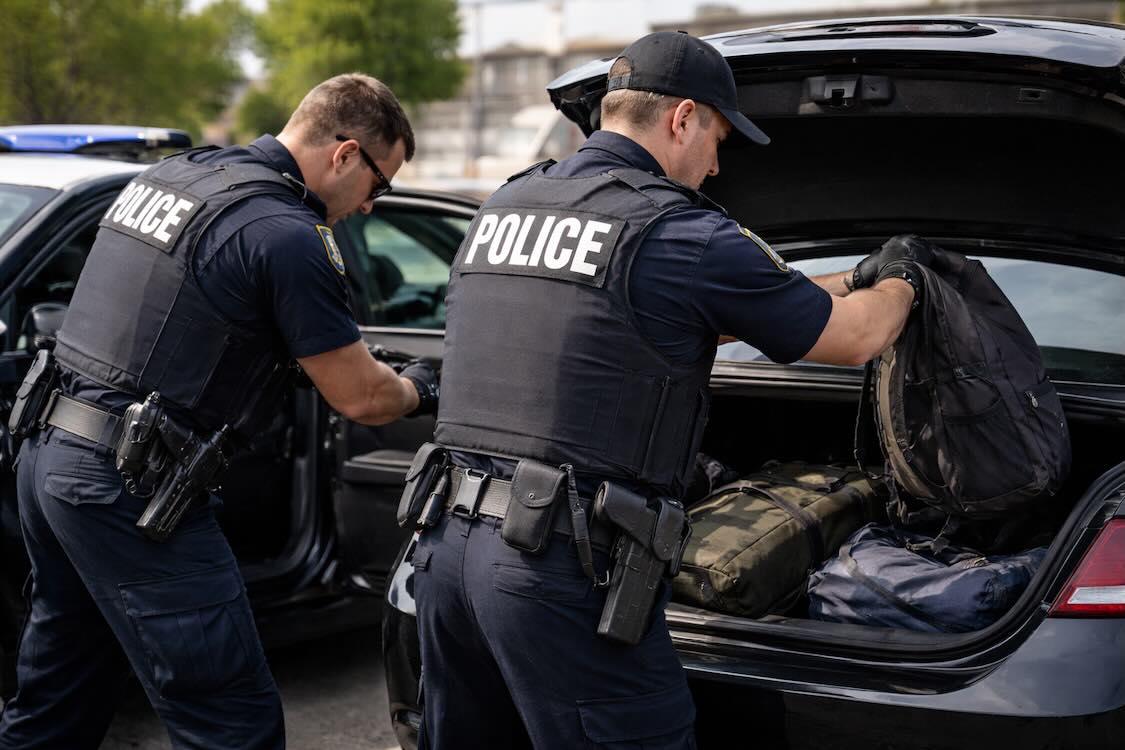
Many criminal cases begin not with an arrest, but with a search. A so-called “quick look” by police can quickly lead to a drug or firearm charge, especially when the search occurs unexpectedly. If you believe officers searched your car, pockets, or home in Eagan without a warrant, the central issue is whether the search was lawful. Understanding Minnesota’s search-and-seizure law is crucial to determining whether evidence can be used against you or if it may be suppressed.
At Arechigo & Stokka, we regularly represent individuals whose cases hinge on whether a search crossed legal boundaries. This article explains probable cause for search in Minnesota, the justifications for warrantless searches, and common defense strategies, particularly in drug and firearm cases.
If you’ve been affected by a search and have questions, don’t navigate this alone. Contact us online or call (651) 222-6603 for a free consultation.
Key Takeaways
- Searches without a warrant are not automatically lawful: In Minnesota, police usually need a warrant unless a specific exception applies and the facts genuinely support it.
- The police must justify each step of the search: A traffic stop, frisk, car search, home entry, or container search each require their own legal basis, especially when drugs or weapons are found.
- Consent and probable cause are often disputed: Many Minnesota criminal cases turn on whether consent was truly voluntary, whether probable cause actually existed, and whether officers expanded the search beyond lawful limits.
- Finding evidence does not cure an illegal search: Even if officers discovered drugs, a firearm, or other contraband, that evidence may still be suppressed if the search violated constitutional protections.
- Early review can change the direction of the case: A defense lawyer can analyze the timeline, body camera footage, reports, and the claimed warrant exception to determine whether a motion to suppress could weaken or dismiss the charges.
What Does “Probable Cause for a Search” in Minnesota Actually Mean?
Probable cause is a legal standard that permits police to seek a warrant and, in some circumstances, conduct searches without one. It requires more than a hunch but less than proof beyond a reasonable doubt. The key question is whether specific facts would lead a reasonable person to believe that evidence or contraband is likely present where police intend to search.
Search warrants require a sworn showing of probable cause and a description of what is to be searched and seized. Minnesota’s Constitution and the Fourth Amendment both protect against unreasonable searches and seizures.
If Warrants Are the Rule, Why Do Warrantless Searches Happen?
A warrant is generally required, but exceptions exist and often become the focus of legal challenges. Police reports typically describe the search as lawful, while the defense challenges that justification.
Minnesota law can, in some situations, offer greater protections than the federal Fourth Amendment, making state-level search challenges extremely important.
What Are the Most Common Exceptions for a Search Without a Warrant in MN?
Police usually justify a warrantless search by citing a specific exception. Common exceptions include:
- Consent—you voluntarily gave permission, verbally or through actions;
- Search incident to arrest—a limited search tied to a lawful arrest;
- Automobile exception—probable cause to believe evidence is in the vehicle;
- Plain view—officers were lawfully present and immediately recognized contraband or evidence;
- Protective sweep or safety check—limited search for safety threats in certain circumstances;
- Inventory search—when a vehicle is lawfully impounded and inventoried under standardized policy; and
- Exigent circumstances—there was probable cause plus a real emergency that made waiting for a warrant unreasonable.
The main issue is not theoretical exceptions, but whether the facts actually justify the search and whether it stayed within lawful limits.
What Are Exigent Circumstances and Why Do Police Rely on Them?
Exigent circumstances refer to situations in which law enforcement claims that immediate action is necessary to avoid the risk of losing evidence, escape of a suspect, or harm to someone. The State often justifies a warrantless search by demonstrating:
- Probable cause to believe evidence or contraband is present; and
- A genuine emergency made it unreasonable to obtain a warrant.
Examples police commonly cite include:
- Hot pursuit of a fleeing suspect believed to have committed a crime;
- Preventing a suspect from escaping;
- Preventing imminent destruction of evidence; or
- Responding to an immediate threat to life or safety, such as hearing screams from inside a residence.
Courts assess these situations based on the totality of the circumstances and an objective reasonableness standard. The question is not what the officer personally believed but what a reasonable officer would have believed under the same facts.
Exigency claims depend on details such as timing, whether the person was secured, whether officers created the urgency themselves, or whether the situation truly required immediate action.
How Do Warrantless Drug Searches Usually Start?
Drug cases often start with a traffic stop, a service call, or a consensual encounter that escalates. Police typically claim a lawful reason to search and then discover controlled substances or paraphernalia.
Law enforcement frequently justifies drug-related warrantless searches through:
- Claiming consent;
- Claiming probable cause based on observations;
- Arguing the automobile exception applies; and
- Assertions of evidence in plain view.
Minnesota courts and lawmakers have addressed cannabis odor as a search justification, and the law now limits reliance on odor alone as probable cause for a search. If officers base a vehicle or home search solely on odor, that issue deserves careful legal review.
What Usually Makes a Drug Search Legally Challengeable?
Raising a challenge to a search can happen even if the police found something. The legal question is whether the police lawfully obtained that evidence. Common challenge themes include whether:
- The stop or expansion of the stop was lawful;
- Consent was truly voluntary and not coerced;
- The search scope exceeded what consent or an exception allowed; and
- Police actually had probable cause at the time of the search, rather than constructing it after the fact.
These circumstances are where an illegal-drug-search defense strategy often begins: by testing the foundation of the search rather than reacting to what was found.
When Can Police Search for a Gun Without a Warrant in Minnesota?
Firearm cases frequently stem from officer safety concerns during stops, disturbance calls, or home entries. Although safety is crucial, it does not automatically supersede constitutional protections, especially in the home.
Warrantless firearm searches commonly arise when police claim:
- They needed to perform a pat-down because someone was armed and dangerous;
- Police required a vehicle area sweep for safety;
- Police entered a home because someone appeared to be in danger; or
- Officers saw a gun in plain view once they were lawfully present.
Cases involving firearms and search-and-seizure law in MN require careful review of whether police had a lawful basis for each step that led to discovery.
What Is the Most Important Distinction in Firearm Searches?
The most critical distinction is scope.
A limited safety frisk for weapons differs significantly from searching containers, and a brief protective sweep is not equivalent to a thorough search of a residence. The defense examines whether the search remained within lawful justification or became an evidence-gathering effort without a warrant.
If Police Found Drugs or a Gun, Can the Evidence Still Be Thrown Out?
Yes. If a search violated constitutional protections under the Minnesota Constitution or the Fourth Amendment, the defense can seek suppression of the evidence. Excluding evidence may weaken the prosecution’s case or significantly affect negotiations.
Suppression analysis often focuses on:
- The timeline of the encounter;
- The exact justification police claim;
- Whether the claimed exception actually applies;
- Whether officers exceeded the lawful scope of the search; and
- Whether the exigency was real or manufactured.
This stage of evaluation is often where a case shifts from the discovery of evidence to the determination that evidence is inadmissible.
Questions About a Warrantless Search?
Search-and-seizure cases turn on precise facts. At Arechigo & Stokka, we focus on what officers knew at the time, their subsequent actions, and whether Minnesota law supports those actions.
Our experienced defense attorneys can:
- Identify the exact warrantless-search theory the State will rely on;
- Obtain reports and available recordings and map the timeline;
- Evaluate probable cause and exigent circumstances claims; and
- Challenge unlawful searches through suppression motions when appropriate.
If your case began with a search without a warrant in MN and later led to drug charges or a firearm allegation, contact us online or call (651) 222-6603 for a confidential consultation. Early review can determine whether the evidence against you is legally admissible.
FAQ
Can police search me without a warrant in Minnesota?
Sometimes, but not automatically. Minnesota police usually need a warrant unless they can prove a recognized exception applies, such as valid consent, a lawful search incident to arrest, probable cause tied to a vehicle, plain view, or a real emergency. Whether the search was lawful depends on the exact facts, not just what officers called it afterward.
Can police search my car without a warrant if they think drugs or weapons are inside?
They may try to rely on the automobile exception, but they still need legally sufficient probable cause. In a Minnesota search without a warrant case, the defense often challenges whether officers actually had enough facts at the time to search the vehicle and whether they exceeded the scope of what the situation allowed.
Does letting officers “take a quick look” count as consent to search?
It can, but only if the consent was truly voluntary. Courts look closely at whether you felt pressured, whether officers used authority or intimidation, what exactly you agreed to, and whether the search went beyond that permission. Consent is one of the most heavily disputed issues in Minnesota drug and firearm cases.
Can police search my pockets or pat me down during a stop?
A limited frisk for weapons is different from a full evidence search. Officers generally must be able to point to specific safety concerns before patting someone down, and that does not automatically permit them to search pockets, containers, or other personal items. Scope matters in every warrantless search analysis.
Can police enter my home in Minnesota without a warrant?
Home entries receive the strongest legal protection. Police usually need a warrant unless they can show a valid exception, such as consent or exigent circumstances involving an immediate emergency. If officers entered first and tried to justify it later, that may create a strong suppression issue.
What are exigent circumstances in a Minnesota search without a warrant case?
Exigent circumstances are situations where officers claim waiting for a warrant was unreasonable because of an immediate threat, likely destruction of evidence, hot pursuit, or danger to others. These claims are fact-specific, and the defense often challenges whether the emergency was real, exaggerated, or created by police conduct.
If police found drugs or a gun, can the evidence still be thrown out?
Yes. The key issue is not just what was found, but whether officers found it lawfully. If a search without a warrant in Minnesota violated constitutional protections, your lawyer may be able to file a motion to suppress the drugs, firearm, or other evidence and significantly weaken the prosecution’s case.
Can an illegal search lead to my criminal charges being dismissed?
It can. If the prosecution loses key evidence after a successful suppression motion, the case may become much harder to prove and may be reduced or dismissed. That is why early review of search-and-seizure issues can be critical in Minnesota drug and weapon cases.
What facts matter most when a defense lawyer reviews a warrantless search?
The timeline is often everything. Your lawyer will look at why police made contact, what they claimed to observe, whether the stop expanded, whether consent was requested, what was searched first, and whether body camera footage or reports match the legal justification the State is now using.
What should I do if I was searched without a warrant in Minnesota and now face charges?
Do not try to explain the case to police or investigators. Save any paperwork, note where and when the search happened, and speak with a criminal defense lawyer as soon as possible. Early review can help identify whether the search was unlawful and whether the evidence can be challenged before the case gains momentum.
Legal Resources Used To Inform This Page:
To ensure the accuracy and clarity of this page, we referenced official legal and authoritative sources during the content development process.
- Probable Cause, Minn. Stat. § 626.08 (2025).
- Unreasonable Searches and Seizures, Minnesota Constitution, Article I, Section 10.
- MinnPost, Court decision ending cannabis odor as sole reason for search codified by Minnesota lawmakers (June 2024).
- Peace Officers; Searches; Pursuit; Mandatory Reporting, Minnesota Statutes, Chapter 626 (2025).
- Definitions, Minn. Stat. § 626.05 (2025).
- Grounds For Issuance, Minn. Stat. § 626.07 (2025).
- Odor Of Cannabis; Search Prohibited, Minn. Stat. § 626.223 (2025).
- Arrest Without Warrant, Minn. Stat. § 629.34 (2025).
- Return of Property and Suppression of Evidence, Minn. Stat. § 626.21 (2025).
- U.S. Congress. U.S. Constitution, Fourth Amendment.
- U.S. Courts, What Does the Fourth Amendment Mean?.
- State Court Report, Minnesota Provides Stronger Search and Seizure Protections Than the Fourth Amendment (March 2024).


 Loading...